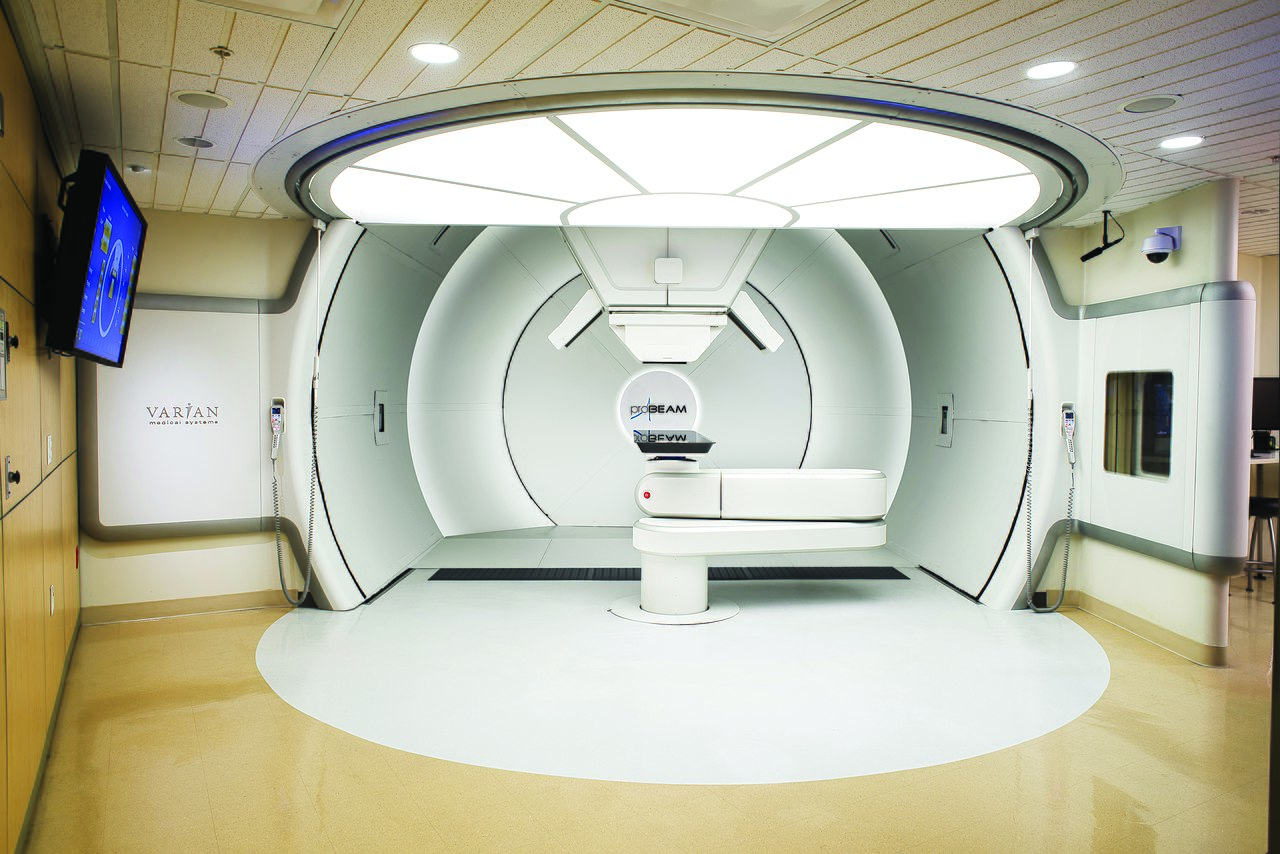
What Is Heavy Ion Therapy — and Why Does It Matter?
Particle therapy uses charged particles instead of conventional X-rays to destroy tumors. The two main types are proton therapy (hydrogen ions) and heavy ion therapy (carbon ions). Both exploit a physical property called the Bragg Peak: the particles deposit maximum energy at a precise depth inside the body, then stop — unlike X-rays, which continue through and damage healthy tissue along their path.
Heavy ion therapy takes this a step further. Carbon ions are roughly twelve times heavier than protons, giving them a biological effectiveness 2–3 times greater than X-rays. This means they can destroy radiation-resistant cancer cells that conventional treatment cannot reach effectively, and they do so in fewer treatment sessions.
| Treatment | Tumor Precision | Normal Tissue Damage | Typical Sessions |
|---|---|---|---|
| Conventional X-ray | Moderate | Widespread | 25–35 |
| Proton therapy | High | Significantly reduced | 15–25 |
| Heavy ion (carbon) therapy | Very high | Minimal | 8–16 |
Only a small number of facilities worldwide can deliver carbon ion therapy. China is rapidly expanding access to this rare treatment modality.
Why China for Particle Therapy?
Scale of Infrastructure
Under the "Healthy China 2030" national strategy, China has invested heavily in particle therapy infrastructure. As of 2026, the country has over 30 proton and heavy ion therapy facilities operational or under construction — more new capacity than any other country.
Among these, several offer both proton and carbon ion therapy, a combination available at only a handful of centers globally.
Cost Advantage
Particle therapy in China costs 30–50% of equivalent treatment in Japan, the US, or Europe.
| Treatment Type | China (Est.) | Japan (Est.) | United States (Est.) |
|---|---|---|---|
| Proton therapy | $7,000–$13,000 | $18,000–$25,000 | $100,000–$180,000 |
| Heavy ion therapy | $8,500–$15,000 | $22,000–$30,000 | Very few facilities |
This pricing reflects China's healthcare cost structure, government subsidies for facility operations, and different labor economics — not lower quality standards. Treatment protocols follow international guidelines, and facilities like SPHIC participate in global clinical trials.
Integrated East-West Medicine
Unlike particle therapy centers elsewhere, Chinese facilities offer something unique: integration with Traditional Chinese Medicine (TCM). Acupuncture for treatment side effects, herbal formulations for immune recovery, and holistic rehabilitation protocols can be combined with cutting-edge radiation therapy. This East-meets-West approach is exclusive to China.
Top Particle Therapy Centers in China
Shanghai Proton and Heavy Ion Center (SPHIC)
SPHIC is China's flagship particle therapy facility and one of the most experienced in Asia.
| Location | Pudong, Shanghai |
| Equipment | Siemens IONTRIS — proton + carbon ion |
| Affiliation | Fudan University Shanghai Cancer Center |
| Patients treated | ~8,900 (as of Jan 2026) |
| Treatment rooms | 4 (including 1 with rotary gantry) |
| Opened | 2014 |
Notable clinical outcomes:
- Locally advanced pancreatic cancer: Median survival 29.6 months with carbon ion therapy (vs. 12–18 months with chemotherapy alone)
- Recurrent head/neck sarcomas: 1-year survival rate 95.9%
- Prostate cancer: 5-year local control rate above 97%
SPHIC was the third facility in the world to offer both proton and carbon ion therapy.
Other Major Facilities
| Facility | Location | Highlights |
|---|---|---|
| Wuwei Heavy Ion Center | Gansu Province | First domestically-built carbon ion system |
| Lanzhou Heavy Ion Center | Gansu Province | Joint research with Chinese Academy of Sciences |
| Shandong Cancer Hospital Proton Center | Jinan, Shandong | Large-scale proton-only facility |
| Taizhou-SJTU Proton Center | Zhejiang Province | Newly operational in 2025 |
Which Cancers Benefit Most?
Best Candidates for Proton Therapy
- Pediatric cancers (brain tumors, neuroblastoma) — reduces developmental side effects and secondary cancer risk
- Head and neck cancers (nasopharyngeal, skull base) — protects brain, hearing, salivary glands
- Skull base tumors (chordoma, chondrosarcoma) — considered the gold standard
- Prostate cancer — comparable outcomes to surgery with fewer side effects
- Eye tumors (uveal melanoma) — preserves vision
Best Candidates for Heavy Ion (Carbon) Therapy
- Locally advanced pancreatic cancer — effective against radiation-resistant tumors
- Bone and soft tissue sarcomas — tumors in surgically challenging locations
- Hepatocellular carcinoma (liver cancer) — non-invasive option for non-surgical candidates
- Recurrent head and neck cancers — cases requiring re-irradiation
- Post-surgical rectal cancer recurrence — localized pelvic recurrences
Not Recommended For
- Blood cancers (leukemia, lymphoma)
- Widely metastatic disease
- Cancers where conventional radiation is equally effective
How International Patients Access Treatment
Step 1: Pre-Consultation and Eligibility Assessment
Particle therapy is a specialized treatment — not every cancer type qualifies. OriEast coordinates with Chinese treatment facilities to evaluate eligibility based on:
- Recent imaging (CT, MRI, PET scans)
- Pathology reports
- Treatment history (surgeries, chemotherapy, prior radiation)
- Blood work
Step 2: Treatment Planning
Once eligibility is confirmed, the medical team at the treatment facility develops a personalized plan. You receive a cost estimate and treatment schedule at this stage.
Step 3: Travel and Treatment
- Visa: M-visa or L-visa for medical travel to China. OriEast assists with the application process
- Duration of stay: 3–5 weeks for proton therapy; 2–4 weeks for heavy ion therapy
- Language support: OriEast provides bilingual coordinators who accompany you to all appointments
- Accommodation: Hospital-adjacent lodging arranged in advance
Step 4: Post-Treatment Follow-Up
After treatment, you return home with a complete treatment summary and imaging data in internationally standard formats. OriEast facilitates communication between the Chinese medical team and your home physicians for ongoing follow-up.
What to Expect: A Realistic Timeline
| Phase | Timeline | What Happens |
|---|---|---|
| Initial inquiry | Day 1–3 | Submit medical records; OriEast reviews and forwards to facility |
| Eligibility assessment | 1–2 weeks | Facility reviews records and confirms candidacy |
| Treatment planning | 1 week after arrival | CT simulation, treatment plan creation, quality checks |
| Treatment | 2–5 weeks | Daily sessions (15–30 minutes each), outpatient for most patients |
| Recovery & departure | 1 week post-treatment | Final scans, discharge summary, travel home |
Next Steps
If you or a family member are considering particle therapy, the first step is a no-obligation eligibility review. Send your current diagnostic reports and imaging through our contact page, and our team will coordinate with the appropriate facility to assess whether heavy ion or proton therapy is a viable option for your case.