← Back to Blog
Cancer Treatment

Proton Therapy in China: Cost, Hospitals, Patient Pathway, and What International Patients Should Know

OriEast Editorial Team2026-04-17

Quick Answer

Use this page to quickly understand what kinds of topics we cover, who the content is most useful for, and where to go next.

Main topics
Cancer Treatment
Best for
A practical guide to proton therapy in China for international patients — who may benefit, how costs usually work, which centers matter, what records are needed, and how the treatment pathway is typically structured.
Best next step
Explore Cancer Treatment in China

Need help applying this to your own case?

OriEast can help turn what you learned here into the right next step for hospital choice, records preparation, or travel planning.

How OriEast helps

We help international patients move from reading and research to real medical coordination in China.

  • Clarify whether this topic is relevant to your case or travel plan
  • Shortlist the right hospital, service, or specialist pathway
  • Review records and reduce planning mistakes before booking
  • Support hospital coordination, travel timing, and next-step questions

Your records are only shared as needed to coordinate planning and specialist review.

Proton Therapy in China: Cost, Hospitals, Patient Pathway, and What International Patients Should Know

Proton therapy in China attracts attention because of a powerful combination: advanced technology, strong oncology infrastructure, and prices that are often dramatically lower than self-pay treatment in the United States. But as with CAR-T, the first useful question is not only “How much does it cost?” The more important question is “Is proton therapy actually the right treatment strategy for this tumor?”

That matters because proton therapy is not a premium upgrade that improves every cancer pathway. It is most valuable when precision changes the clinical trade-off — especially when the tumor sits near critical structures, when normal tissue sparing matters greatly, or when the tumor type is especially suited to particle therapy. In some cases, heavy ion therapy may also enter the discussion, which adds another layer of complexity.

This guide explains proton therapy in China from the perspective of an international patient: who may benefit, how costs usually work, which centers matter, what records should be prepared before travel, how the treatment pathway is structured, and where patients often make costly planning mistakes. If your main concern is the broader cancer-care budget picture first, start with our Chinese hospital costs for foreigners guide.

The Short Answer: Who Proton Therapy in China May Be Right For

Proton therapy in China is often most relevant for patients whose tumor characteristics make precision especially important.

This may include patients with:

  • skull base tumors
  • head and neck cancers near critical anatomy
  • selected pediatric cancers
  • certain prostate cancers
  • selected liver tumors
  • tumors where prior radiation or normal tissue constraints make standard radiation less attractive

In some cases, heavy ion therapy may be considered when radioresistance or other disease-specific factors make it clinically attractive.

The key point is that tumor location, prior treatment, and radiation planning logic matter more than marketing labels. A patient should not assume that proton therapy is automatically the best treatment simply because it is more technologically advanced.

What Proton Therapy in China Usually Costs

For international patients, the most important pricing truth is that a proton therapy course is not one simple number. The cost depends on:

  • the center
  • whether proton or heavy ion therapy is being used
  • the number of fractions
  • treatment planning complexity
  • whether additional hospital services are needed
  • whether accommodation and coordination are included outside the hospital pathway

Practical Cost Logic

Cost LayerWhat It Usually Covers
Radiation oncology reviewConsultation, case review, indication discussion
Planning workupImaging, contouring, simulation, immobilization
Treatment courseThe delivered fractions or sessions
On-treatment managementMonitoring during the course
Follow-upReassessment and post-course review

For many international patients, the strongest value in China is that even after travel and accommodation, the total particle-therapy pathway may still be far below US self-pay treatment.

Why Headline Prices Can Mislead

Patients often see a center-level treatment price and assume it covers the full journey. In reality, patients should clarify:

  • how many sessions are included
  • whether consultation and planning are separate
  • whether physician review is bundled
  • whether accommodation is included or separate
  • whether post-treatment monitoring is included

This is why the most trustworthy proton page explains the treatment pathway, not just the technology and one price figure.

Proton Therapy vs Heavy Ion Therapy: What Is the Difference?

For many patients, China becomes especially interesting because some centers offer both proton and heavy ion capabilities or are associated with pathways where both are discussed.

Proton Therapy

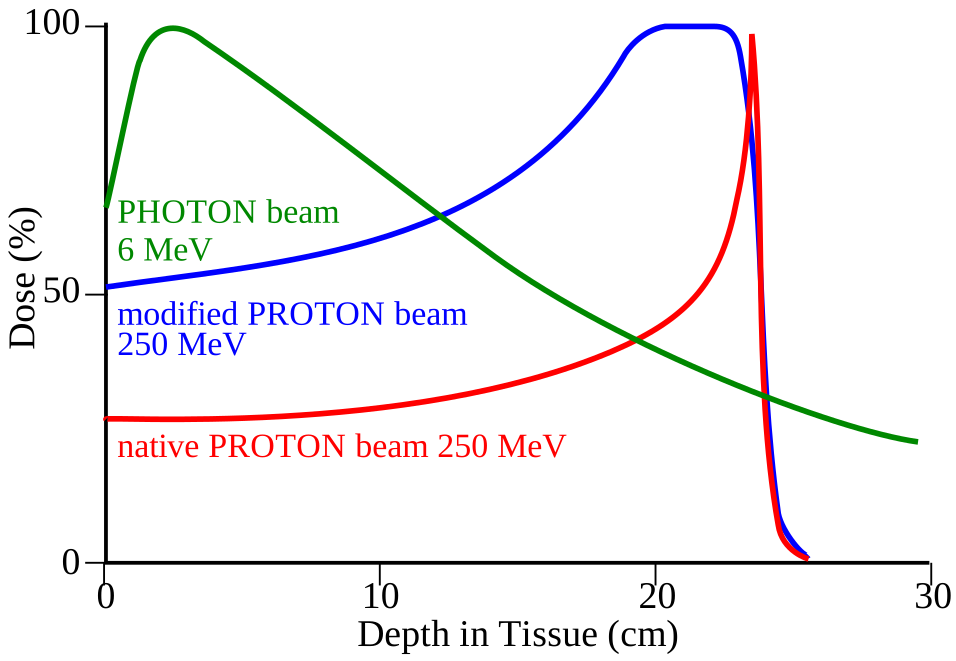
Proton therapy is valued for its ability to deliver highly precise radiation while reducing unnecessary dose to surrounding normal tissue.

This makes it especially useful when:

  • tumors are close to critical structures
  • long-term toxicity matters greatly
  • the patient is younger or pediatric
  • conventional radiation would create a worse trade-off

Heavy Ion Therapy

Heavy ion therapy is often discussed for certain tumors where stronger biological effect may matter, especially in selected radioresistant cases.

This is not a universal upgrade over proton therapy. It is a different tool whose value depends on the disease and planning logic.

The correct question is not “Which one is more advanced?” but “Which modality makes the most clinical sense for this case?”

Which Centers Matter Most in China?

For international patients, the most important centers are specialized particle-therapy institutions and major hospitals with strong radiation oncology integration.

Shanghai Proton and Heavy Ion Center (SPHIC)

SPHIC is often the most internationally visible center in China because of its specialization and its role in proton and heavy ion treatment pathways.

It is especially relevant because:

  • it is built specifically around particle therapy
  • it is one of the best-known centers in China for international patients evaluating this option
  • it is highly relevant in discussions of selected head and neck tumors, skull base tumors, prostate cancer, liver tumors, and pediatric use cases

Other Important Pathways

Depending on the case, other centers or hospital-associated radiation oncology pathways may also matter. Patients should not over-focus on one center name before clarifying disease fit.

What Records Should Be Prepared Before Review?

Particle therapy is planning-intensive. Before a meaningful review can happen, the patient usually needs a structured record package.

Core Records

  • pathology report
  • diagnosis summary
  • recent imaging (CT, MRI, PET-CT where relevant)
  • operative note if surgery already occurred
  • prior treatment history
  • prior radiation records if the patient has already received radiation
  • current disease status summary

Why Prior Radiation Records Matter So Much

If the patient has already had radiation, prior dose maps and treatment records may be especially important because re-irradiation logic can depend heavily on what has already been delivered.

Incomplete records can delay or distort the review.

What the Proton Therapy Patient Pathway Usually Looks Like

The patient pathway matters more than many patients expect because proton therapy is not usually a one-visit service.

PhaseWhat Happens
Pre-travel case reviewDetermine whether particle therapy is likely appropriate
On-site evaluationConfirm indication, imaging, planning suitability
Simulation and planningImmobilization, contouring, physics planning
Treatment courseDaily fractions over a defined treatment period
Monitoring during treatmentClinical review and management during the course
Follow-upPost-course imaging or reassessment as appropriate

This means patients should think in terms of weeks, not a single appointment.

Who May Not Be a Good Fit for Proton Therapy Travel?

This is a critical trust section.

A patient may not be a strong fit if:

  • the tumor does not benefit meaningfully from particle therapy
  • another treatment route is more appropriate
  • the records are too incomplete for meaningful planning
  • the patient assumes proton therapy is always superior simply because it is more advanced
  • the travel burden outweighs the likely planning value

Not every patient with cancer should travel internationally for proton therapy.

The Most Common Planning Mistakes

Assuming Proton Therapy Is Automatically Better

It is better when the case specifically benefits from precision. It is not automatically better for every oncology pathway.

Focusing on the Center Before the Indication

The center matters, but the indication matters first.

Treating the Treatment Price as the Whole Budget

Patients often underestimate planning, accommodation, and follow-up-related costs.

Traveling Before Records Are Reviewed

This creates unnecessary cost and emotional uncertainty.

When OriEast Is Especially Useful

OriEast is especially useful when a patient needs to turn a technically complex radiation option into a real travel decision.

This matters when:

  • the patient is unsure whether proton or heavy ion therapy is even appropriate
  • records need to be organized before a specialist review
  • the center choice depends on diagnosis and prior treatment history
  • cost, travel, and pathway timing need to be aligned before committing

In these cases, the value is not just scheduling a consultation. It is helping the patient determine whether the pathway makes clinical and logistical sense first.

Frequently Asked Questions

How much does proton therapy cost in China?

For international patients, proton therapy in China often remains well below US self-pay pricing, but the total depends on the center, number of fractions, treatment planning complexity, and related travel or accommodation costs.

What is the difference between proton therapy and heavy ion therapy?

They are both particle therapies, but they differ in physical and biological effect. Heavy ion therapy may be more relevant for certain selected radioresistant tumors, while proton therapy is already highly valuable for precision treatment.

Which patients may benefit most from proton therapy in China?

Patients with tumors near critical structures, selected pediatric cancers, certain head and neck tumors, skull base tumors, prostate cancer, liver tumors, and other precision-sensitive cases may be among the strongest candidates.

Which centers matter most?

Specialized particle therapy centers and major hospitals with strong radiation oncology pathways matter most. The right center depends on diagnosis and planning logic, not just geography.

What records should I prepare before coming to China for proton therapy?

Patients usually need pathology, imaging, prior radiation details if applicable, treatment history, operative notes where relevant, and a concise diagnosis summary before a meaningful review can happen.

Should I travel first and ask later whether proton therapy is right for me?

Usually no. Because particle therapy is highly indication-dependent, patients should ideally complete pre-travel review before committing to travel.


If you are evaluating proton therapy in China, the next step should not be a generic technology inquiry. It should be a record-based review to determine whether the tumor is actually a good fit for proton or heavy ion treatment before travel.

Primary CTA: Submit records for review

If you need the broader China cost framework first, start here:

Secondary CTA: Request a cost estimate


Related Reading


This article is informational only and does not replace oncology or radiation oncology advice. Particle therapy suitability must be determined by qualified specialists based on diagnosis, imaging, prior treatment history, and treatment-planning considerations.

Next step

If this topic is relevant to your treatment or travel plan, these pages are the best next place to continue.